The Crossroads of North America
For more than two decades, Hartsfield-Jackson Atlanta International Airport (ATL) has proudly held the title of the world’s busiest airport by passenger traffic. Situated just south of downtown Atlanta, Georgia, ATL operates on a scale that defies standard aviation metrics. Its success is rooted in geographical serendipity—being within a two-hour flight of 80% of the United States population—and an incredibly efficient structural layout designed for high-volume domestic transfers.
The Mega-Hub Layout
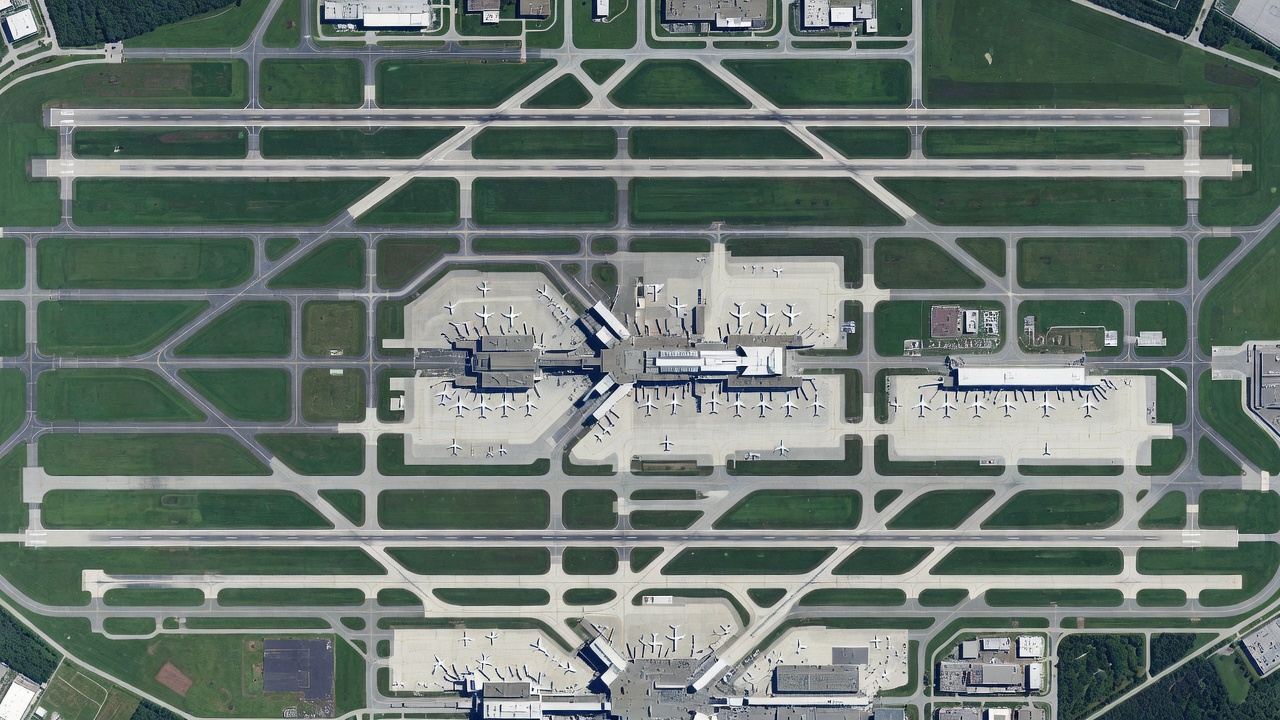
Unlike airports that sprawl organically, Atlanta’s design is a masterclass in linear efficiency. The airport consists of two main landside terminal complexes (Domestic and the Maynard H. Jackson Jr. International Terminal) flanking a series of parallel concourses (T, A, B, C, D, E, and F).
This "midfield concourse" design means that aircraft can taxi between the concourses without interrupting operations on the five parallel runways. It is an arrangement built purely for logistical speed, allowing rapid turnarounds for the dominant carrier, Delta Air Lines, which operates its primary mega-hub here.
The Plane Train
Moving millions of connecting passengers between these parallel concourses requires a robust transit solution. The automated people mover (APM) known as the Plane Train runs in a tunnel beneath the concourses, operating on a looped track. Trains arrive every two minutes, swiftly shifting passengers along the spine of the airport. Parallel to the train tunnel is a pedestrian walkway, famous for its art installations, providing an alternative route for those who prefer to walk.
Delta's Dominance
It is impossible to discuss ATL without noting the deep integration of Delta Air Lines. The airline accounts for the vast majority of operations at the airport. This concentration creates a formidable network effect, allowing Delta to offer an unmatched number of daily departures to destinations across North America, South America, Europe, and Asia. The efficiency of this single carrier's hub-and-spoke operation is the engine that drives ATL’s massive passenger numbers.
Ground Connectivity
For passengers beginning or ending their journey in Atlanta, the airport connects directly to the Metropolitan Atlanta Rapid Transit Authority (MARTA) rail system. The MARTA station is integrated directly into the Domestic Terminal, providing a cost-effective and traffic-free link to downtown, Midtown, and Buckhead. Additionally, a large consolidated rental car facility (CONRAC) is connected to the terminal via a separate Skytrain system, keeping shuttle bus traffic away from the main terminal curbsides.